
How to use Conversational AI
Key takeaways
- Conversational AI lets you ask questions about your documents using natural language.
- The tool can analyze one or multiple documents at the same time.
- Responses include linked references to supporting text segments in your data.
- Conversational AI is available in ATLAS.ti Windows, Mac, and Web.
- You can code referenced segments directly from the AI responses.
Who this article is for
This article is for ATLAS.ti Windows, Mac, and Web users who want to explore, understand, and analyze qualitative data using AI-assisted conversations.
What is Conversational AI?
Conversational AI is an AI-powered research assistant built into ATLAS.ti that allows you to “chat” with your documents.
Instead of manually searching through large amounts of text, you can ask questions in natural language, such as:
- “What are the main concerns participants mentioned?”
- “How do interviewees describe workplace stress?”
- “What themes appear across these focus groups?”
- “Which passages discuss trust in institutions?”
Conversational AI analyzes your selected documents and generates answers based on their contents.
Unlike general-purpose AI chatbots, ATLAS.ti Conversational AI also provides direct references to the text segments supporting each answer. This makes the analysis process more transparent and easier to verify.
What can Conversational AI help with?
Conversational AI can support many stages of qualitative analysis, including:
- Exploring large document collections
- Identifying themes and patterns
- Summarizing discussions or interviews
- Comparing perspectives across documents
- Discovering contradictions or outliers
- Generating ideas for coding and interpretation
- Quickly locating relevant passages
The tool is especially useful during early-stage exploratory analysis or when working with extensive datasets.
Use this replacement section:
Use Conversational AI in ATLAS.ti Windows and Mac
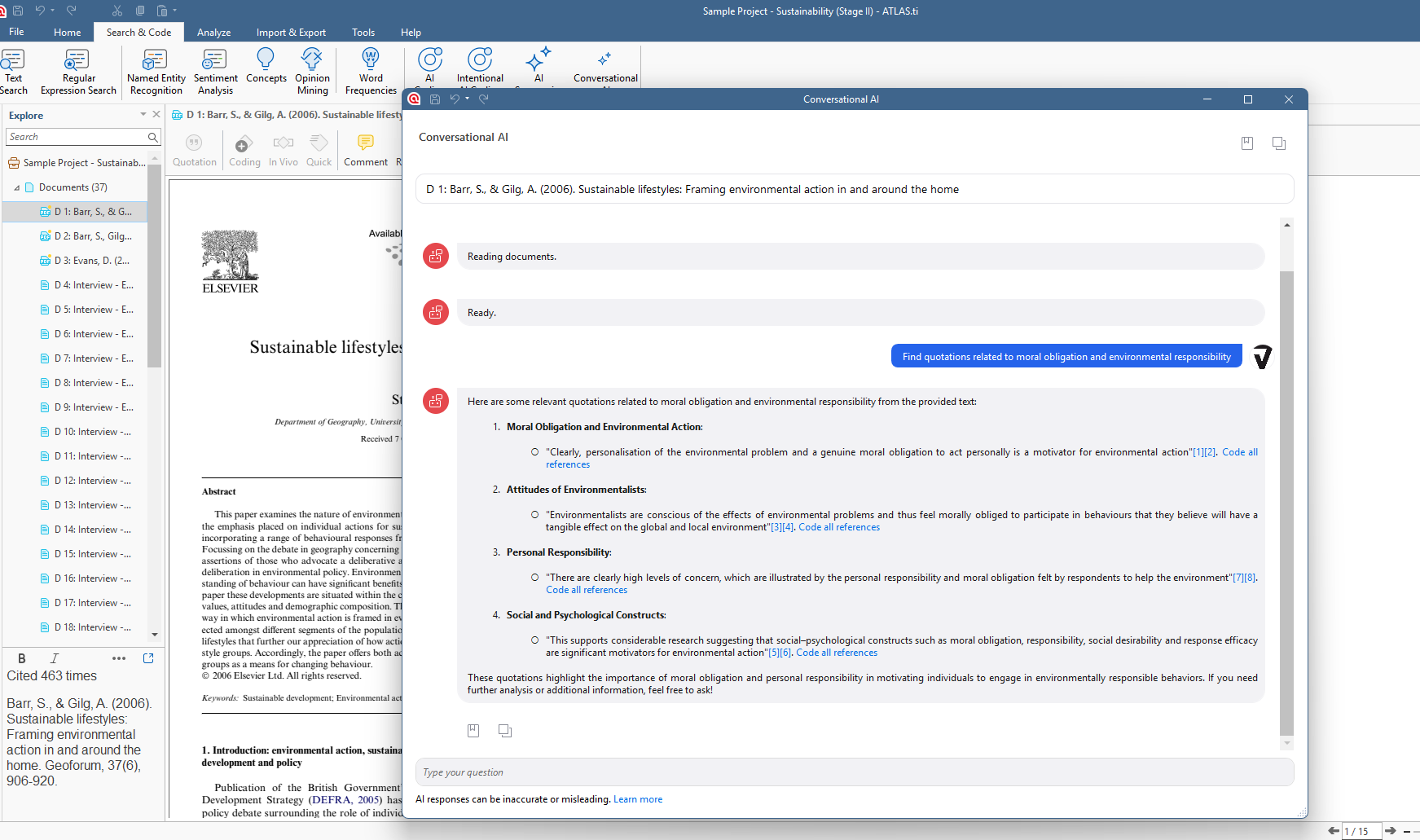
You can open Conversational AI in ATLAS.ti Windows and Mac in several ways.
In ATLAS.ti Windows, go to Search & Code > Conversational AI.
In ATLAS.ti Mac, go to Analysis > Conversational AI.
Then select one or more documents and start chatting with your data.
You can also right-click a document and select Analysis > Conversational AI on both Windows and Mac.
Use Conversational AI in ATLAS.ti Web
To open Conversational AI in ATLAS.ti Web:
-
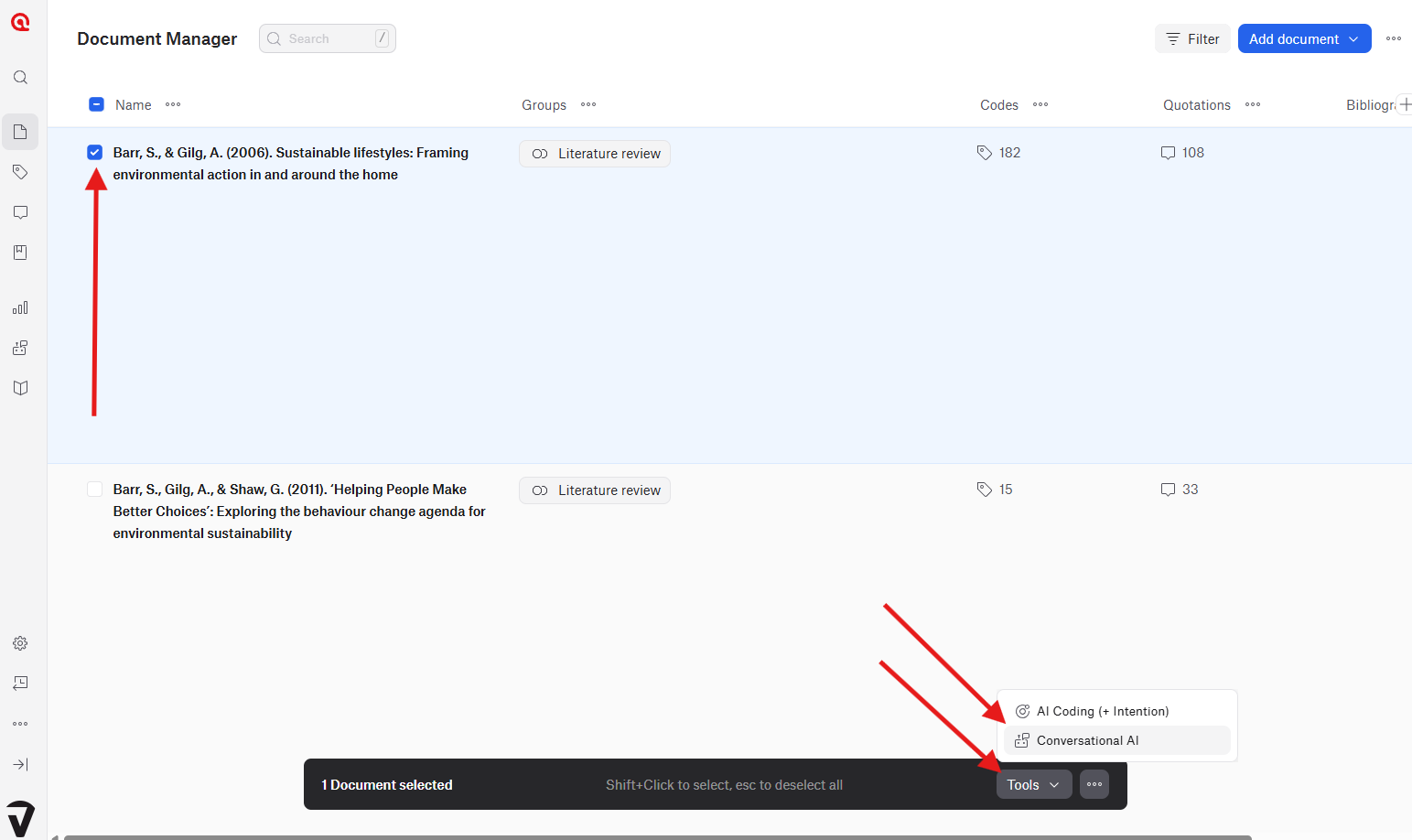
Select your document(s). Click on Tools > Conversational AI.
-
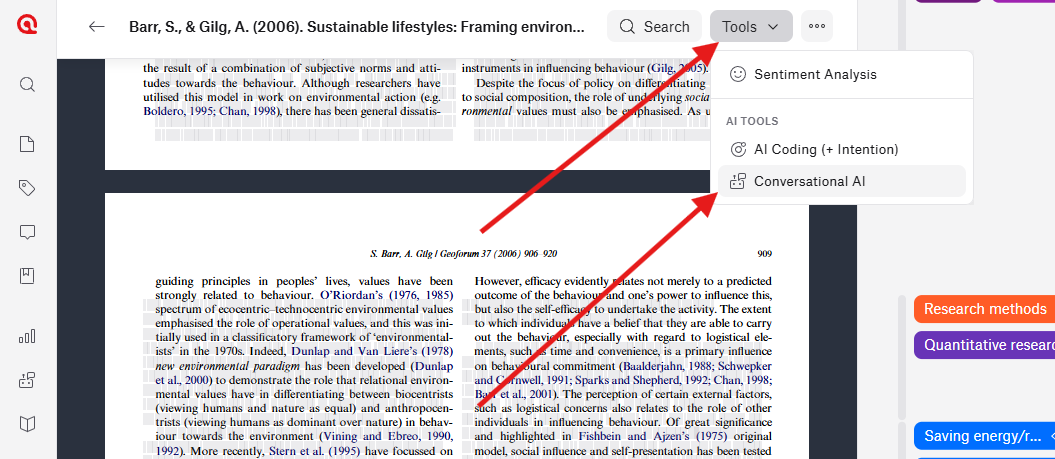
Or simply open the document and select Tools > Conversational AI.
-
- Accept the EULA and Privacy Policy agreement.
- Click Start with chat.
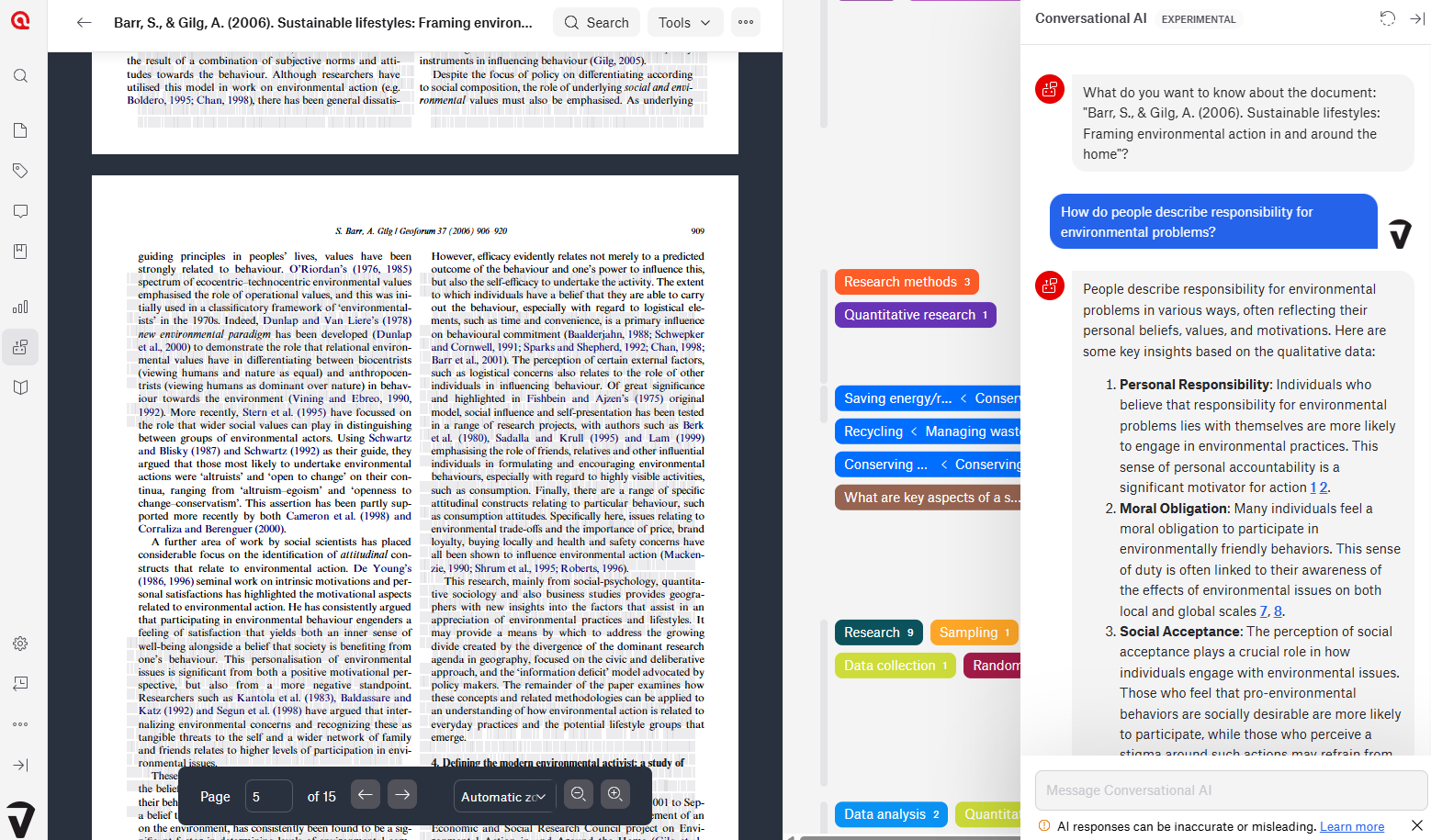
The AI will process the selected documents in the side-window to the right. You can start your conversation there.
How Conversational AI works
After loading your documents, you can ask questions in natural language through the chat interface.
Conversational AI uses OpenAI GPT models to analyze your selected document content and generate responses.
Each answer includes linked references to supporting quotations from your documents. Clicking a reference opens the related text segment in context so you can:
- Review the source material
- Create quotations and apply codes
- Continue deeper analysis
You can also use the Code all references option to quickly code all referenced segments connected to an answer.

Save and reuse AI conversations
Conversational AI includes options to:
- Copy individual responses
-
Copy entire conversations

-
Create memos from question-and-answer pairs

This allows you to preserve insights generated during exploratory analysis and integrate them into your research workflow. You can provide feedback on AI-generated answers using the thumbs down icon
After selecting feedback, a dialog box allows you to add comments explaining your experience.
This feedback helps improve Conversational AI over time.
Best practices for using Conversational AI
Conversational AI performs best when:
- Documents in the conversation are related to the same topic
- Questions are specific and focused
- Metadata is included directly inside documents if needed for analysis
For example, if participant age or demographic information is important for interpretation, include that information in the document text before starting the conversation.
You can also improve results by:
- Rephrasing questions
- Asking follow-up questions
- Narrowing the focus to specific topics or themes
- Reviewing the supporting references carefully
As with any AI-assisted analysis, researchers should critically evaluate all generated responses.
Important limitations
Conversational AI currently:
- Does not automatically understand document names, document groups, or existing coding structures
- Relies only on the text content included in the selected documents
- May occasionally generate incomplete or inaccurate interpretations
Conversational AI is currently a beta feature and may change over time.
Privacy and data processing
Conversational AI uploads your questions and selected document content to ATLAS.ti and OpenAI servers for processing.
Your data is only uploaded after you explicitly agree to the EULA and Privacy Policy.
OpenAI does not use ATLAS.ti user data to train OpenAI models.
Please note: Conversational AI currently uses US-based servers only. This applies regardless of your selected AI Region setting
Common issues and mistakes
- Expecting perfect factual accuracy
- AI-generated responses should always be reviewed against the referenced source material.
- Asking overly broad questions
- Large or vague questions may produce less focused answers. More specific prompts usually improve results.
- Assuming the AI understands project structure
- Conversational AI does not automatically interpret document groups, document names, or coding systems unless this information appears in the document text itself.
- Forgetting to review references
- The supporting references are an important part of transparent qualitative analysis and should always be checked carefully.
When to contact support
Contact support if:
- Conversational AI does not open
- The chatbot icon is missing
- Documents fail to load into the conversation
- References cannot be opened
- AI responses never generate
- You cannot accept the privacy agreement